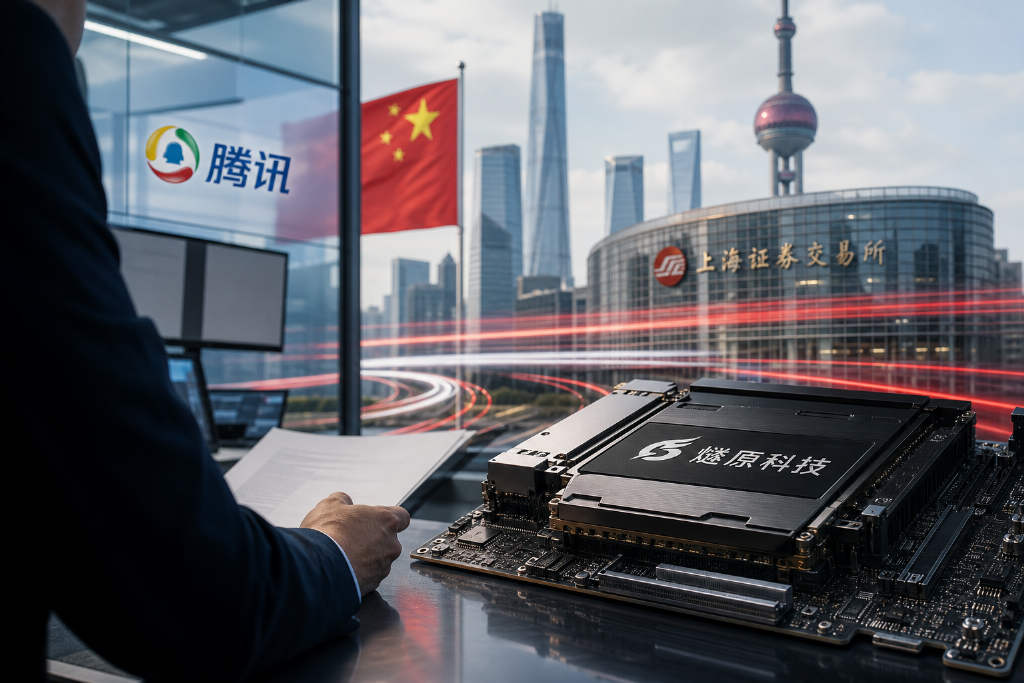
Suiyuan Techn2026-09-02 07:54:12Suiyuan Technology Opens Subscription for $6.1 Billion-Value GPU IPOChinese GPU developer Suiyuan Technology opened subscription for its STAR Market offering on Sept. 2 at 142.18 yuan per share, implying a market capitalization of about 61.2 billion yuan. With 500 shares in a standard lot, a successful retail applicant would need to pay roughly 71,100 yuan. The offering drew 337 institutional investors and 11,805 placement accounts during preliminary price inquiries. After invalid bids and the highest quotes were removed, the proposed off-exchange subscription volume reached 72.959 billion shares, or 2,648.93 times the initial allocation size. Xiaomi, GigaDevice, Fullhan Microelectronics, ZTE and the National Social Security Fund appeared on the strategic placement list. Tencent is central to the offering. Tencent Technology directly held about 19.95% of Suiyuan before the offering, while Tencent-related entities held 20.26% and formed the largest institutional shareholder group. Tencent accounted for 83.79% of Suiyuan’s revenue in 2025. Revenue rose from 301 million yuan in 2023 to 990 million yuan in 2025, and first-half 2026 revenue reached 1.12 billion yuan. Suiyuan expects basic break-even in 2026 and profitability no later than 2027, while acknowledging its continued dependence on Tencent and the limited scale of its L600 mass production.1160
MoneyFrontier2026-07-30 05:03:00MoneyFrontier summit spotlights four shifts in AI compute, from domestic GPUs to AIDC upgradesAt the MoneyFrontier 2026 New Infrastructure Intelligent Computing Summit held on July 28 at Hong Kong’s Hopewell Hotel, executives from Moore Threads, Tencent Cloud, Yanji Microelectronics and Xinke Liquid Cooling outlined how the AI compute chain is changing shape. Their talks converged on a common view: the market is moving away from a simple race over who owns the most GPUs and toward a harder question of who can turn compute capacity into usable production systems. Moore Threads said domestic GPUs are entering a “token era,” where demand is no longer defined by chip performance alone but by full-stack support across training, inference, simulation, agent runtime and end applications. Tencent Cloud focused on the rise of AI agents, arguing that enterprise deployment now depends on memory, knowledge management, tool use, multi-agent coordination and secure execution environments, not just large models. Yanji Microelectronics founder Yang Zuoxing said the training market has become concentrated and that new openings are more likely to emerge on the inference side, especially as AI applications, agents and robots spread toward regional and edge scenarios. Xinke Liquid Cooling, for its part, said the shift from traditional data centers and blockchain mining sites to AIDC facilities is an engineering overhaul involving power, cooling, networking, fire protection, operations and delivery standards.1980